
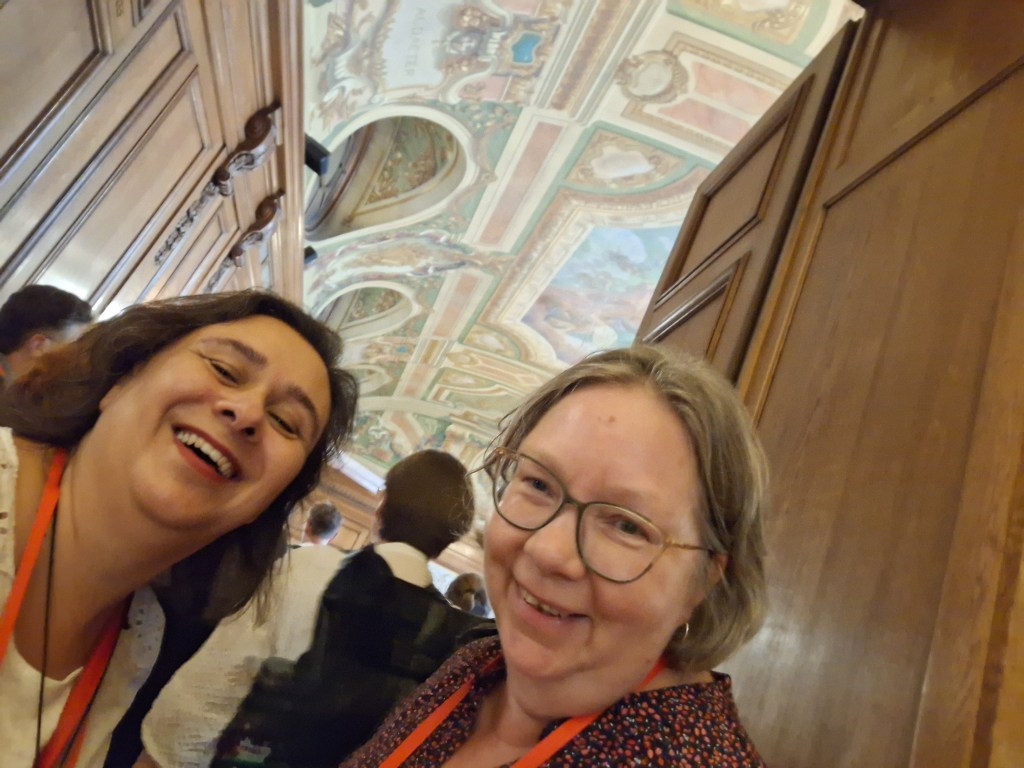
Text: Özlem Terzi, Monica Tennberg and Marjo Lindroth
Photo: Özlem Terzi
This summer CAS has contributed a section on ‘Spaces of Sustainabilities, Struggles of Transitions in the (European) Arctic and Beyond’ to the Pan-European Conference of the European International Studies Association (EISA-PEC). EISA is the Europe-wide organization for the study of International Relations (IR) and has evolved from the Standing Group on IR of the European Consortium for Political Research (ECPR). This year’s EISA-PEC took place between 27-31 August 2024 at the Université Catholique de Lille in France. This section was organized by CAS members Monica Tennberg and Özlem Terzi and brought together some of the regular members of the CAS Thematic Network with other researchers from the Arctic region or from other parts of Europe.
The section consisted of a roundtable and three panel sessions, which were all well attended. The roundtable session on ‘What, Why and How Critical Arctic Studies? Another Regional Studies or Something Else’ aimed at introducing the CAS Network to a wider audience. This session was moderated by Monica Tennberg (University of Lapland) and the speakers included Marjo Lindroth (University of Lapland), Özlem Terzi (Vrije Universiteit Amsterdam), Page Wilson (University of Iceland) and Marlene Payva Almonte (University of Lapland), all of them researchers from different stages of their careers and representing different fields of expertise, but all engaged with a critical approach to their study of the Arctic region.
The discussions in the roundtable focused on what different members understood from the ‘Critical’ in the title of CAS. The discussions also reflected on what CAS contributes to regional studies in general and the study of IR in particular. We agreed that the Arctic Studies as well as our critical approach to it has a lot of contribution to make to both of these fields through conceptualisations, comparisons, thick descriptions and lived experiences of the cases we work on.
We also discussed about two different ways of doing research about the Arctic: one of them being ‘researching the Arctic from the Arctic as its inhabitants’, and the other as ‘outside academics doing most of the research from an ‘armchair’ and visiting the Arctic only occasionally’. We agreed that the local and external perspectives on the Arctic nourish and enrich each other, bringing about livelier discussions, as it most probably goes also for other regional studies. We need both local and external scholarly interest in the Arctic. Both approaches eventually feed into a wider conceptualization of a significant range of IR topics.
The three panel sessions that followed this roundtable focused on the governance of change, green transition, identities and affect. The papers presented examples of the various research agendas on the Arctic politics and its governance through law and institutions, social and political psychology, self-perceptions, human-nature relations, challenges of the green transition and climate change, potential cooperation and sources of conflict. It was not only us CAS people talking but it was a also good way to engage with the broader IR community to learn about each other’s research in and about the Arctic.
The three full days provided lots of opportunities for our section participants to get to know each other better as well as those from similar sections, for example through the social lunch with the members from the section on Polar Regions and Oceans. It was great to see other IR colleagues, getting to know each other’s research better and expanding the network of CAS for future collaborations with them.
We have very much enjoyed organizing this section as a CAS initiative. We are now looking forward to future endeavors: Keep an eye on our participation at the Arctic Circle Assembly with a session on the Arctic Military (In)securities: Critical Reflections and the upcoming CAS Annual Symposium on ‘Thinking with Water: Exploring the Edges’, both in October!
 Thematic Network on Critical Arctic Studies