
Text & photo: Tom Royer
September truly feels like a dynamic month for the CAS Network, packed with conferences! I had the pleasure of heading to Lund, Sweden, where I joined fellow researchers from Akureyri, Tromsø, Nottingham, Stavanger, and beyond. We gathered in this charming, cobblestone town to delve into discussions about the poles as part of the Critical Legal Conference 2024, subtitled “Speculation(s)”.
We participated in three distinct panels, each offering a different angle on our theme. The first panel kicked off with a semi-circle gathering, true to its name: “Conversations on Polar Speculation(s) and the Legal Imagination.” Mana Tugend (UiT) invited us to ponder two thought-provoking questions:
- “In this dystopian world, where law is failing to resolve environmental crises, what room is left for legal imagination?”
- “How do we speculate a better future? Is a better future possible through law?”
The discussion that followed was incredibly refreshing, bringing together researchers with diverse but interconnected interests: climate refugees, ocean governance, Indigenous rights, sustainable fishing, geoengineering, and more. It was a genuine pleasure listening to various perspectives on the role of law (and legal research), pondering what constitutes failure, and debating whether we’re living in a dystopian reality or if that’s merely a convenient narrative for a select few. Often, we say that a discussion leaves us with “more questions than answers,” but in this case, it felt like we gained an equal measure of both—or perhaps the questions themselves were a form of answers.
Panel 2 shifted the focus to water. “Tides of Connection: The Water We Share” (reference to CHVRCHES?), Mana Tugend’s short film, opened the floor in such a poetic, contemplative manner, inviting us to think about water with tenderness—perhaps even a touch of solastalgia. Those moments spent in the cabin by the shore, the puffins, the whales—each element brought the ocean’s splendour to life. Then, Sofie Quist (UiT) transported us to the ‘ends of the world,’ examining the salmon farms in Chile and Norway and the shadow ecologies of transnational corporations. While their supposed ‘sustainability’ harms coastal ecologies and Indigenous rights, there’s still hope: both nature and local communities are pushing back, struggling for multispecies justice. Monica Tennberg would have enjoyed this ‘fishy talk’!
Irene Sacchetti (Nottingham Trent University) contributed with a tender insight too, screening the ecopoetic expedition “Rise: From One Island to Another”. This work is a striking dialogue between islanders from the Marshall Islands and Kalaallit Nunaat (Greenland), connecting their lived realities. It served as part of Irene’s presentation on climate refugees and the complexities surrounding identity, including issues like Tuvalu’s digitalization and the Tokelauans’ refusal of the ‘climate refugee’ label: “We are not drowning, we are fighting!”. Indeed, who decides when a land becomes ‘uninhabitable’?
I had the honour of participating in the final panel alongside Romain Chuffart (University of Akureyri) and Aaron Cooper (Stavanger University). Romain provocatively embodied carbon itself, questioning: “Trees and rivers might have standing, and I don’t?!” His presentation delved into the theoretical nature of carbon, challenging whether it’s simply a ‘by-product’ or a ‘legal object.’ Aaron, on the other hand, explored geoengineering and the responsibility that comes with this endeavour of world-making. How does the law help shape our world, and is it equipped to handle such complex objects full of ‘inorder’?
My presentation (or “performance”, in the words of one audience member) concluded the series of panels by asking about the fine line between environmental security and military security, in the context of spaceport development in the Arctic: if the Arctic Council were to take on the task of addressing Earth-space sustainability, would this be a challenge to its mandate?
The rest of the Critical Legal Conference 2024 offered a wonderful opportunity to explore new areas of critical legal enquiry, such as Critical Legal Geography, Science-Fiction and the Law, and the Aesthetics of Law. I also deepened my understanding of Critical Posthumanism and the fascinating concept of ‘more-than-human subjects,’ learning innovative ways to approach research in this field. Sensible keynote speeches brought further reflections on the nature of Critical Legal Studies, feminism, capitalism, technological ‘progress,’ and academic communities.
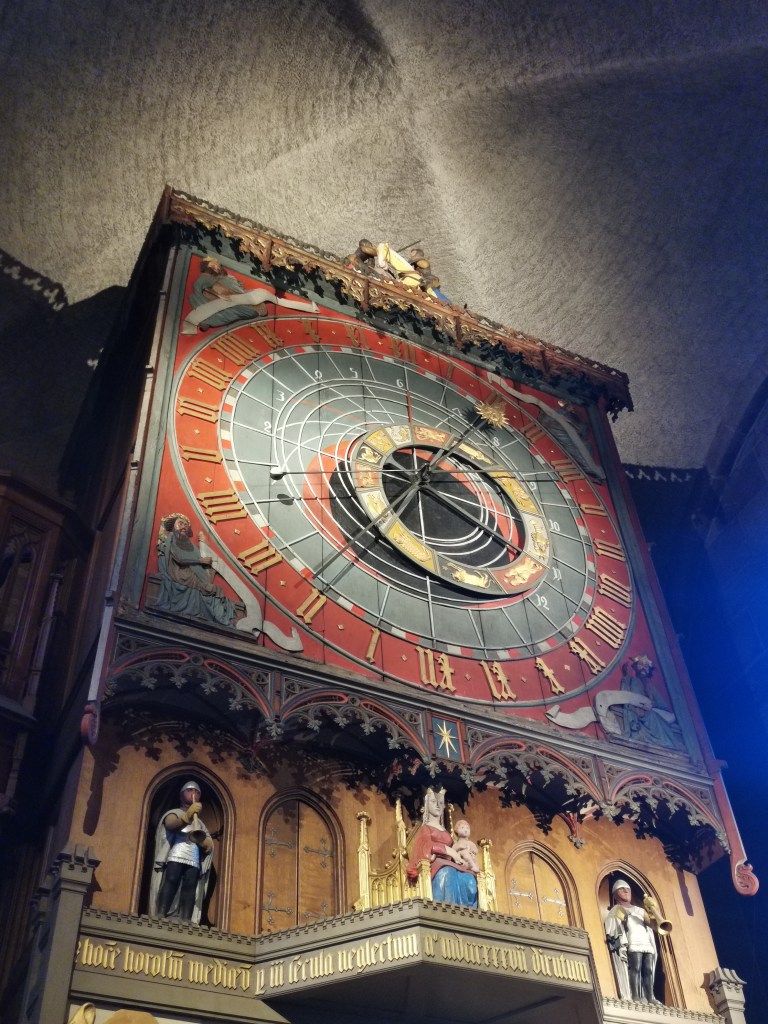
Lastly, my time in Lund was enriched by exploring the town itself—a quaint place with cobbled streets, a warm atmosphere, beautiful parks (Lundagård, the Botanical Garden, and Stadsparken), a magnificentfifteenth-century astronomical clock, and some truly unique museums, such as Skissernas Museum: The Museum of Sketches for Public Art. And, of course, I couldn’t resist indulging in the delicious cardamom buns at Broder Jakobs Stenugnsbageri! Vilken njutning! (= What a treat!)
To paraphrase Olivia Newton-John: next year, once again, let’s get critical, critical! ♪
Tom Royer is a Ph.D. candidate in Space Law at the University of Lapland, investigating Earth-Space sustainability and commercial spaceports in Northern Europe from a critical post-human perspective. At the Arctic Centre, Tom is part of the Critical Arctic Studies Team. Besides, Tom co-coordinates the Calotte Academy 2024 Travelling Symposium. Finally, Tom is on the Management Committee of COST Action FOGOS (“Futures-Oriented Governance of Outer Space: Towards Peace, Equity and Environmental Integrity”).
 Thematic Network on Critical Arctic Studies